The Complete PgMP Guide: Master Program Management Professional Certification in 2026
1. Introduction: Why Program Management Matters in 2026
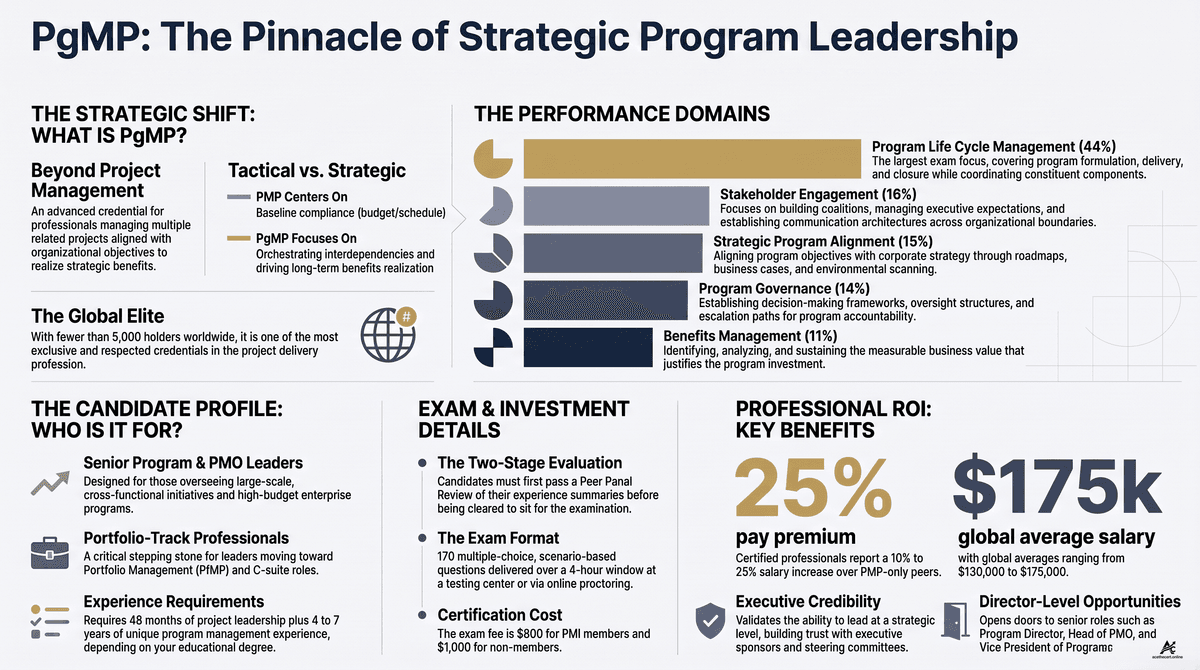
The Program Management Professional (PgMP) certification from PMI validates your ability to manage multiple, related projects in a coordinated way to achieve strategic benefits that would not be possible if managed independently. In the complex business environment of 2026, organizations seek PgMP-certified leaders who can align programs with organizational strategy and deliver transformative outcomes.
Test your program management knowledge across all domains: Domain 1: Strategic Program Management | Domain 2: Program Life Cycle | Domain 3: Benefits Management | Domain 4: Stakeholder Engagement | Domain 5: Program Governance.
2. The Role of a Program Manager
A program manager orchestrates multiple projects and operational activities. Unlike a project manager who focuses on outputs, the program manager focuses on outcomes and benefits. Key responsibilities include:
- Aligning program objectives with organizational strategy.
- Managing interdependencies between component projects.
- Engaging senior stakeholders and governing bodies.
- Ensuring the realization of program-level benefits.
- Adapting to changes in the external and internal environment.
3. Eligibility Requirements
The PgMP sets a high bar for entry, requiring documented program management experience:
- With a 4-Year Degree: 48 months (4 years) of project management experience + 48 months of program management experience within the last 15 years.
- With a Secondary Degree: 48 months PM experience + 84 months (7 years) of program management experience.
All candidates undergo a Panel Review — a rigorous evaluation of your experience summaries by a panel of certified program managers before you even sit for the exam.
4. The Five Performance Domains
The PgMP exam evaluates mastery across five interlocking domains:
| Domain | Weight | Focus |
|---|---|---|
| Strategic Program Management | 15% | Aligning programs with organizational goals, defining the program roadmap. Quiz → |
| Program Life Cycle | 44% | Initiating, planning, executing, controlling, and closing the program and its components. Quiz → |
| Benefits Management | 11% | Defining, tracking, and realizing program benefits throughout the lifecycle. Quiz → |
| Stakeholder Engagement | 16% | Identifying, analyzing, and engaging stakeholders to secure support and manage expectations. Quiz → |
| Program Governance | 14% | Establishing program-level governance structures, policies, and decision-making frameworks. Quiz → |
5. Exam Structure and Strategy
- 170 questions (150 scored, 20 pretest)
- 4 hours duration
- No scheduled breaks
- Psychometric scoring with Above Target/Target/Below Target/Needs Improvement ratings
Key Strategy: The Program Life Cycle domain weighs the heaviest at 44%. Allocate disproportionate study time here, but do not neglect Governance and Stakeholder Engagement, which collectively account for 30%.
6. The Panel Review: Your Gateway to the Exam
The PgMP is one of the few PMI certifications requiring a Panel Review. A panel of certified program managers evaluates your experience summaries. Tips for success:
- Write your experience in STAR format (Situation, Task, Action, Result).
- Emphasize your role in program-level activities, not project-level.
- Demonstrate how you managed interdependencies between projects.
- Show evidence of strategic alignment and benefits realization.
7. Study Resources and Timeline
Plan for 3–6 months of dedicated study. Recommended resources:
- The Standard for Program Management (5th Edition): The foundation document.
- PMI Program Management Professional (PgMP) Handbook: Official exam policies.
- PgMP Exam Practice Tests: Simulate the 170-question format and time pressure.
- PMI Study Hall: Official practice environment.
8. Benefits of PgMP Certification
- Salary Premium: PgMP holders are among the highest-paid PMI certification holders.
- Executive Visibility: The certification signals readiness for VP and Director-level roles.
- Strategic Impact: Proves your ability to deliver strategic, organization-wide benefits.
- Global Recognition: Validates your competency with the world’s most respected project management institute.
9. Renewal and Maintenance
PgMP renewal requires 60 PDUs every 3 years, aligned with the PMI Talent Triangle:
- Ways of Working: At least 8 PDUs.
- Power Skills: At least 8 PDUs.
- Business Acumen: At least 8 PDUs.
- Remaining 36 PDUs can be distributed across any category.
10. Your Path to PgMP Certification
- Confirm Eligibility: Audit your program management experience.
- Prepare Experience Summaries: Write compelling, STAR-format narratives.
- Submit Application and Panel Review: Allow 4–6 weeks for review.
- Study the Five Domains: Use the official Standard for Program Management.
- Take Mock Exams: Target consistent 70%+ scores.
- Pass the Exam and Lead Programs: Begin your journey as a certified program management professional.
Frequently Asked Questions
What is the difference between PgMP and PMP?
What are the PgMP eligibility requirements?
What domains are covered on the PgMP exam?
How many questions are on the PgMP exam?
How do I maintain my PgMP certification?
Ace The Cert Team
The official editorial team for Ace The Cert.
Related Posts
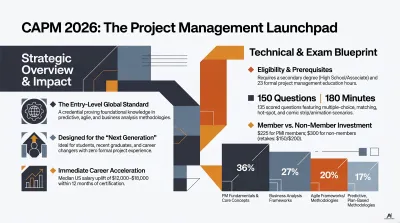
The Ultimate 2026 CAPM Certification Guide: Your Gateway to Project Management
Pass the CAPM exam on your first try. Learn eligibility, costs, the 4 domains, study roadmap, and career paths for aspiring project managers in 2026.
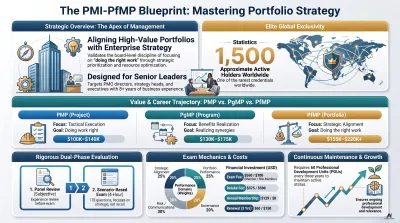
The Complete PfMP Guide: Master Portfolio Management Professional Certification in 2026
Earn the PfMP and master portfolio management. Learn eligibility, 5 domains, panel review process, and proven strategies to pass the PfMP exam on your first try.
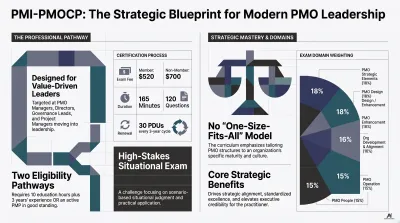
The Complete PMI-PMOCP Guide: Master PMO Professional Certification in 2026
Lead strategic PMOs. Master the PMI-PMOCP with our guide to eligibility, 6 domains, PMO Value Ring, exam structure, and proven prep strategies for 2026.
Comments are not configured for this site.