The Definitive PMI-ACP Guide: Master Agile Leadership Across All Frameworks in 2026
1. Introduction: The Strategic Rise of the Agile Practitioner
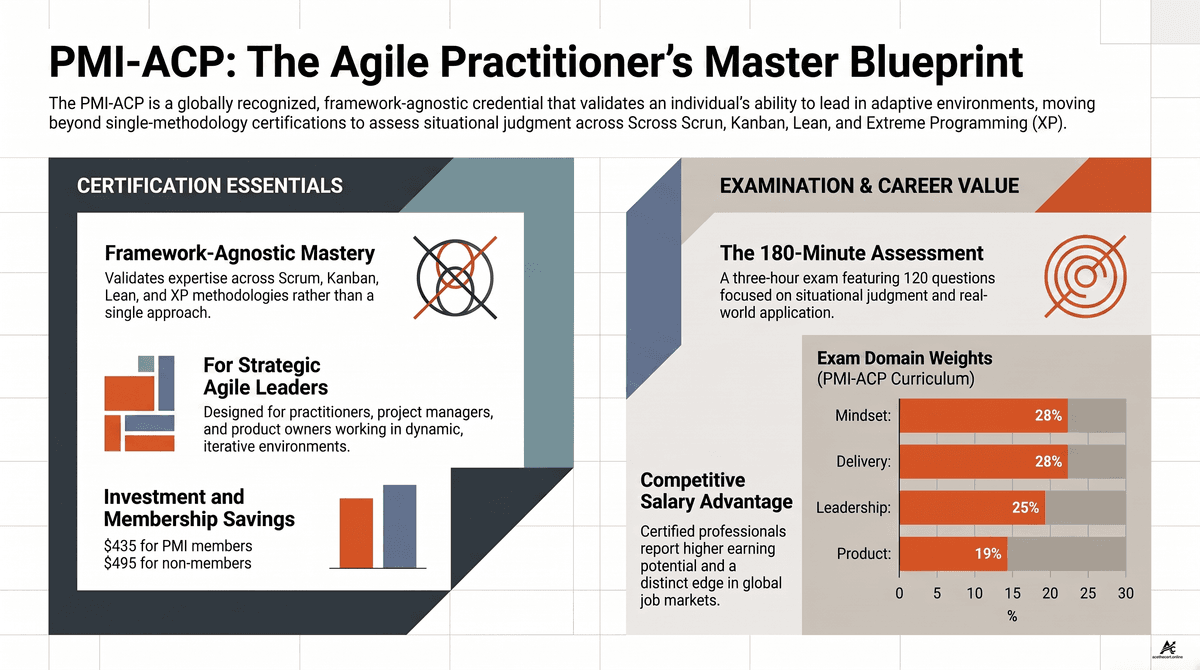
In the professional climate of 2026, agile has completed its evolution from a niche IT methodology to the dominant strategy for organizational survival. As enterprises navigate the complexities of AI-driven markets and global volatility, they no longer seek practitioners who are merely “certified” in a single toolset. Instead, they demand leaders who possess a deep, framework-agnostic competency. The PMI-Agile Certified Practitioner (PMI-ACP) has emerged as the premier credential because it proves a professional can transcend role-specific boundaries to deliver value across the entire enterprise.
Put your agile mindset to the test: Domain 1: Mindset | Domain 2: Leadership | Domain 3: Product | Domain 4: Delivery.
2. The Multi-Framework Architecture: Beyond “Doing” Agile
Versatility is the primary currency of the 2026 agile leader. Being “framework-neutral” allows a practitioner to evaluate a project’s unique constraints and select a “fit-for-purpose” approach. The PMI-ACP syllabus is intentionally broad:
- Scrum: Core agile roles, rituals, and iterative cycles.
- Kanban: Flow management, WIP visualization, and lead-time metrics.
- Lean: Enterprise agility via waste identification and value stream mapping.
- Extreme Programming (XP): Technical excellence, technical debt, pair programming.
- Design Thinking: Human-centered problem-solving in early agile delivery.
- Hybrid Methods: Bridging predictive (Waterfall) and adaptive (Agile) models.
3. Target Audience: Identifying the Ideal Candidate
| Role | Value Added by the PMI-ACP |
|---|---|
| Agile Project Manager | Validates multi-framework leadership and value flow. |
| Scrum Master | Expands toolkit to Kanban and XP practices. |
| Agile Coach | Framework-neutral foundation for situational coaching. |
| Product Owner | Backlog refinement and stakeholder engagement. |
| Business Analyst | Strengthens Value-Driven Delivery and Stakeholder Engagement. |
| Team Lead | Servant leadership and psychological safety for high performance. |
4. Eligibility Pathways and Application Prerequisites
PMI maintains high eligibility standards to protect the credential’s market value:
- Educational Background: A secondary degree (or global equivalent).
- Agile Training: Exactly 21 contact hours of agile-specific education.
- General Project Experience: 2,000 hours (12 months) — waived if you hold an active PMP.
- Agile-Specific Experience: 1,500 hours (8 months) on agile project teams within the last three years.
5. Financial Investment and Exam Logistics
| Category | Cost (2026 Pricing) |
|---|---|
| PMI Member Exam Fee | $435 |
| Non-Member Exam Fee | $495 |
| PMI Annual Membership | $174 |
The exam consists of 120 questions (20 non-scored pre-test) with a 3-hour duration. There are no scheduled breaks, requiring precise stamina management.
6. The Seven Domains of the Examination Content Outline (ECO)
The ECO has expanded to include AI-enabled delivery, GenAI, and Sustainability.
- Agile Principles and Mindset: Internalizing agile values and the 12 principles. Practice →
- Value-Driven Delivery: Delivering high-value increments through flow metrics. Practice →
- Stakeholder Engagement: Mapping power-interest grids and transparent communication.
- Team Performance: Empowerment and psychological safety through servant leadership. Practice →
- Adaptive Planning: Fit-for-purpose lifecycles and tailored processes.
- Problem Detection and Resolution: Identifying and resolving impediments.
- Continuous Improvement: Retrospectives and feedback loops. Practice →
7. Official Prep Resources
- The Agile Practice Guide (2nd Edition): Primary reference with AI/GenAI integration and Sustainability.
- PMI Study Hall: Official practice questions mirroring exam logic.
- The Mike Griffiths Collection: “PMI-ACP Exam Prep” and “Agile Illustrated.”
- Udemy: Joseph Phillips (comprehensive, 13+ hours) or Andrew Ramdayal (high-impact, 9 hours).
8. Navigating the Challenge: Psychometrics and Passing Scores
The PMI-ACP is a psychometric exam. You must embody servant leadership. Success requires targeting 70% or higher on situational mock exams.
9. Market Value: Salary Potential and Comparative Advantage
PMI-ACP holders report a 15–22% salary advantage over non-certified peers. The ACP proves you can adapt to any organizational system, making you more “future-proof” as AI-augmented methods evolve.
10. The Step-by-Step Path to Certification
- Confirm Eligibility: Audit your education and agile experience.
- Fulfill 21 Contact Hours: Select a high-impact course (Ramdayal or Phillips).
- Master the ECO Domains: Track domain-level performance in mocks.
- Simulation and Mock Exams: Target 70%+ on situational simulations.
- Application and Exam Booking: Submit to PMI and schedule your slot.
11. Conclusion: Future-Proofing Your Career with Agility
The PMI-ACP signals that you can navigate complexity, manage flow, and lead with a servant’s heart. In a world of “part machine, part human” project delivery, your ability to apply situational knowledge across frameworks is your ultimate career insurance.
Frequently Asked Questions
What is the difference between PMI-ACP and CSM?
What are the PMI-ACP eligibility requirements?
How many domains are on the PMI-ACP exam?
How much does the PMI-ACP exam cost?
How many PDUs are required for PMI-ACP renewal?
Ace The Cert Team
The official editorial team for Ace The Cert.
Related Posts
The Ultimate 2026 CAPM Certification Guide: Your Gateway to Project Management
Pass the CAPM exam on your first try. Learn eligibility, costs, the 4 domains, study roadmap, and career paths for aspiring project managers in 2026.
The Complete PfMP Guide: Master Portfolio Management Professional Certification in 2026
Earn the PfMP and master portfolio management. Learn eligibility, 5 domains, panel review process, and proven strategies to pass the PfMP exam on your first try.
The Complete PMI-PMOCP Guide: Master PMO Professional Certification in 2026
Lead strategic PMOs. Master the PMI-PMOCP with our guide to eligibility, 6 domains, PMO Value Ring, exam structure, and proven prep strategies for 2026.
Comments are not configured for this site.